TO GENERALIZE MAY LEAD TO LIES
- Burton Ashworth
- Jul 11
- 3 min read

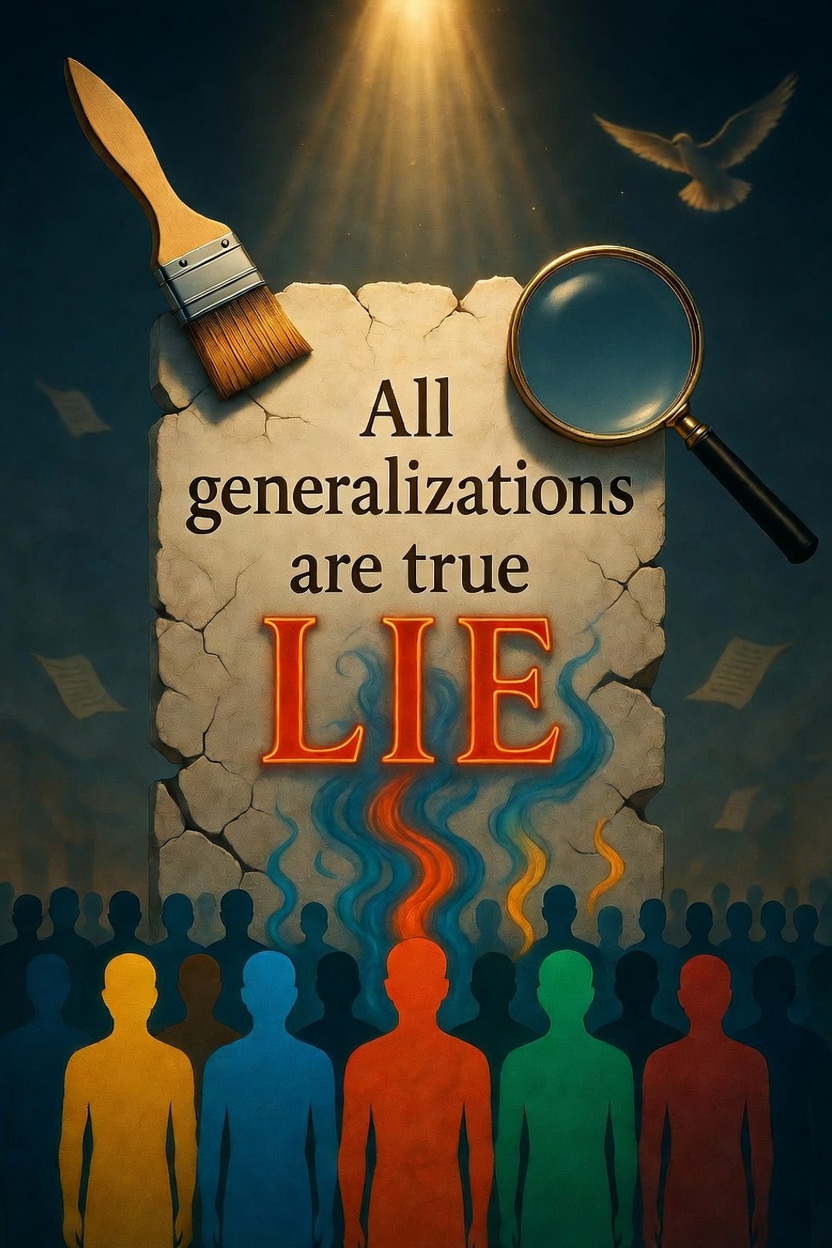
Have you ever heard someone say, "He never reads the Bible," simply because they never saw that person with an open copy of the Scriptures? Or perhaps you’ve heard the generalization, “Those people are all the same. They are lazy. They are unspiritual. They are just plain wrong.” These are rather confident statements. They sound like observations. They are not observations at all, more often than not. They are generalizations, and generalizations have a dangerous tendency to become lies. In fact, when I was thinking of a title for this blog, I was going to call it “To Generalize Leads to Lies.” Then it hit me that that title would be a generalization. I had to include the "may" to keep it generic.
It is so tempting, in a culture that feeds on snap judgments and viral tags, to paint with a broad brush. But the Bible calls for a higher standard. It demands precision in our words. It warns, "That every idle (unemployed, inactive) word that men shall speak, they shall give account thereof in the day of judgment" (Matthew 12:36). And the ninth commandment is still binding when it says, “Thou shalt not bear false witness against thy neighbor” (Ex. 20:16). Generalizing without evidence is often bearing false witness without knowing it.
Generalization is taking a limited observation (or no real observation at all) and making it a universal claim. From "I haven't seen this" to "This never happens." It goes from “This person did that” to “Everyone like him does that.” The jump is big, and the landings are often false. Note the first example. You have never seen a brother or sister open a Bible in public. And from this lack of evidence, you conclude they do not read the Word of God. But the absence of evidence is not evidence of absence. Perhaps they arise before daylight to have a little quiet time with the Lord. While driving, working, or walking, they may hide the Word in their heart. They may be deeply devoted in private but modest in public. You say, ‘They do not read the Bible.’ That is not a careful observation. It is a fact in the shape of a supposition. And a lie is an assumption presented as a fact. The second example is even more common, in which a whole category of people is painted with a negative description. "All the young people today are rebelious." Or "All old people live in the past." Or, “All politicians are crooked.” Such statements seem to be true descriptors. They save us the trouble of really knowing people. But they also destroy the image of God in people by making them a stereotype. Righteous judgment is replaced by lazy prejudice.
Jesus Himself warned us of this very tendency. In John 7:24, He said, “Judge not according to the appearance, but judge righteous judgment.” Righteous judgment requires evidence, context, and humility. Generalization does not require any of those things. All it takes is a quick mouth and a closed mind. Proverbs 18:13 states it plainly, saying, “He that answereth a matter before he heareth it, it is folly and shame unto him.” When we judge a person's character based on incomplete information, we answer a matter before we hear it. We are talking trash about that person or those people. And when that foolishness is presented as truth, we have entered into falsehood. James 1:19 gives us the antidote when he writes, “Wherefore, my beloved brethren, let every man be swift to hear, slow to speak, slow to wrath.” Its opposite, generalization, is folly. It is quick to speak and slow (or entirely unwilling) to listen.
The world is already full of peddlers of stereotypes and half-truths. The church ought to be different. We are called to be people of the Name. People who treat the Word with care. And therefore, we treat each other with care. James 3 says the tongue is a fire, a world of iniquity. A single offhand generalization can fan a blaze that will smolder for years. One wrong assumption about a brother’s spiritual life can hurt a relationship, discourage a soul, or even quench a genuine work of God that we just never took the time to see.
Let us therefore choose the harder, narrower way. The path of exact speech, of charitable assumption, and of waiting for evidence before we make judgments. Let us remember that the same Lord who searches the hearts of others searches our hearts as well. He knows when we have talked more than we know. Any comments?


Comments